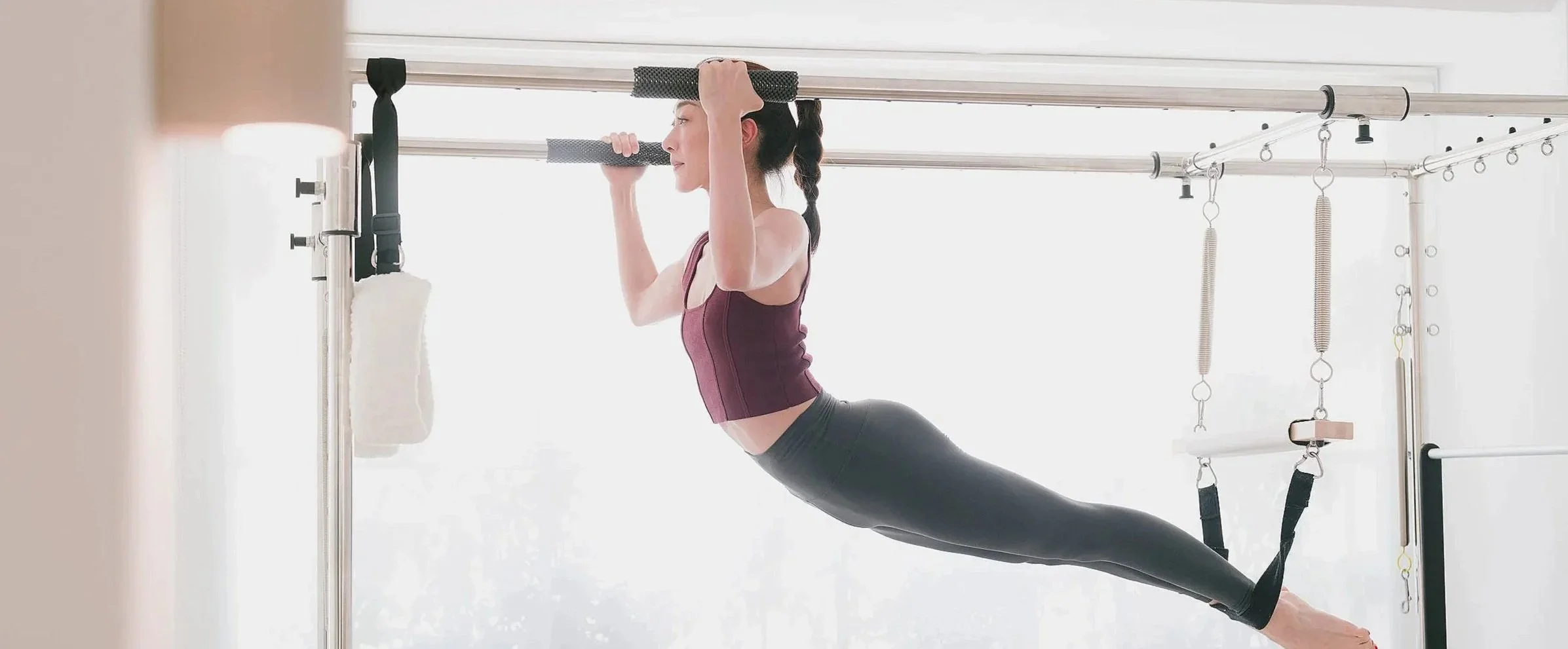
How do we work on safe backbends in different kinds of exercise systems?
Very often we see backbends in different movement systems, such as in Pilates, Gyrotonic, & Yoga practices. Quite a few students mentioned they had past injuries related to backbending, creating lower back pain traumas that comes on and off.
Pilates approach backbends as Spinal Extension, focusing on axial elongation, coming down to one fundamental mechanical rule: “create length before depth.”
Because the lower back (lumbar spine) naturally bends easily, the body tends to hinge and dump all pressure into the lower vertebrae. Safe backbending requires distributing the curve evenly across the entire spine, supported by strong core activation and open hip flexors.
Here are a few tips for you!
Engage Your Deep Core (Transverse Abdominal): Safety Prerequisite.
Before leaning back, draw your belly button lightly toward your spine and up toward your heart. This engages the transverse abdominal, acting like a natural weight belt that decompresses the lumbar discs and prevents pinching in the lower back.
Shift the Bend to the Thoracic Spine: Upper Back Focus.
Inhale deeply and lift your chest upward toward the ceiling, as if pulling your ribcage away from your hips. Imagine bending over a beach ball placed behind your shoulder blades rather than hinging at your waist. The upper back (thoracic spine) should do the majority of the bending.
Open the Shoulders & Hip Flexors: Pre-Requirement Mobility.
Tight shoulders and tight psoas/quadriceps force the lower back to compensate. Open your hip flexors in low lunges and release tight chest muscles before entering deep backbends.
如何在各式運動體系中安全地進行後彎?
在不同的運動體系(如普拉提、Gyrotonic 和瑜伽練習)中,我們經常能看到後彎動作。不少學生曾提到自己過去因後彎而受過傷,導致下背疼痛反覆發作、形成長期困擾。
普拉提將後彎視為一種「脊椎伸展」,強調「中軸延伸」,其核心可歸納為一條黃金法則:「先創造空間與長度,再追求深度。」
由於腰椎(下背)天然具備較大的活動度,人體往往容易過度折腰,將所有壓力集中傾倒在下段椎骨上。安全的後彎需要將彎曲弧度勻稱地分攤在整條脊椎上,並以強健的深層核心力量與髖屈肌群作為支撐。
以下為你提供幾個保護脊椎的實用技巧!
1. 啟動深層核心(腹橫肌):安全的首要前提
在身體向後傾斜之前,將肚臍微微向上往心臟方向提引。這樣能有效啟動腹橫肌,如同為腰椎戴上一條天然護腰帶,進而為腰椎間盤減壓,防止下背夾擠。
2. 將彎曲點轉移至胸椎
深吸氣,將胸口向上朝天花板提·升,彷彿將肋骨向上拉高。想像你的肩胛骨後方有一顆沙灘球,身體是順著球體弧度向上伸展,而非直接從腰部折角。後彎的主要弧度應由上背(胸椎)來承擔。
3. 先增加肩膀與髖屈肌群的活動度
緊繃的肩膀以及僵硬的腰大肌與股四頭肌,會強迫下背承擔過多的補償壓力。在進入深度後彎之前,可先透過低弓步式等動作伸展髖屈肌,並釋放胸部肌群的緊張感。

When Stability Creates Function in Pilates
If you’ve ever taken a Pilates class, you’ve probably heard your instructor talk about "the Powerhouse" or "finding your center." It sounds great in theory, but what does it actually mean for your body?
In Pilates, the secret to effortless, pain-free movement comes down to one core concept: stability creates function.
It sounds counterintuitive at first. How does keeping part of your body still help you move better? Think of your body like a crane. If the base of the crane is wobbly or unanchored, trying to lift a heavy load will tip the whole machine over. But anchor that base firmly to the ground, and the arm can lift, rotate, and reach with incredible power and precision.
Your body operates on the exact same principle. Here is how building a stable center unlocks true functional strength in your everyday life.
1. Protecting Your Joints
Dynamic movement without stabilization is a recipe for joint strain. When your pelvis and spine are stabilized in optimal alignment, force gets distributed evenly across your muscles rather than sinking into your lower back, knees, or shoulders. Stability ensures your joints stay centered in their sockets, reducing long-term wear and tear on cartilage and ligaments.
2. Training Smart Muscle Patterns
Without deliberate stability work, larger global muscles (like your hip flexors or upper traps) overcompensate for lazy deep stabilizers. Pilates retrains your nervous system to fire those deep, stabilizing "anchor" muscles first, right before you move.
3. Translating Strength to Daily Life
Pure strength without stability is rarely useful outside the gym. True functional fitness is about resilience—being able to bend over to pick up a toddler, twist to grab something from the back seat, or stumble on an uneven sidewalk without throwing out your back. Stability provides the system that keeps dynamic movement safe.
By anchoring your center, you stop relying on tension and start moving with control. The next time you're holding a steady neutral pelvis on the mat, remember: you aren't just holding a pose—you’re building the engine for every step, reach, and lift you’ll make for the rest of your day.
What specific area of your movement routine—like running, lifting, or day-to-day posture—are you hoping Pilates will help you improve?
穩定造就功能
如果你曾上過普拉提課,大概聽過教練不斷提及「核心」(Powerhouse)或「尋找身體的中心點」。這聽起來很抽象,但究竟對我們的身體意味著什麼? 在普拉提的世界裡,輕鬆且遠離疼痛的動作秘密,歸根結底來自一個核心概念:穩定造就功能(Stability creates function)。 這乍聽之下有點違背直覺:讓身體的一部分保持不動,怎麼反而能幫助我們更好地移動?
不妨將身體想像成一台起重機。如果起重機的基座搖晃不穩,嘗試吊起重物時整台機器就會翻覆;相反地,只要將基座牢牢固定在地面上,吊臂就能以驚人的力量與精準度進行提升、旋轉與延伸。 你的身體運作原理完全相同。
普拉提如何為你的日常生活解鎖真正的功能性力量?
1. 保護關節
缺乏穩定性的動態姿態,是造成關節拉傷的根源。當骨盆與脊椎穩定在最佳排列位置時,作用力會均勻分散至肌肉組織,而非直接壓迫下背、膝蓋或肩膀。穩定性可確保關節保持在關節窩的中心,減少對軟骨與韌帶的長期磨損。
2. 訓練肌肉運作模式
如果缺乏針對性的穩定度訓練,較大的表層肌肉群(如髖屈肌或上斜方肌)就會過度代償,替偷懶的深層穩定肌群幹活。普拉提能重新訓練神經系統,讓深層穩定肌群在動作發生的「瞬間前」優先啟動。
3. 將力量轉化為日常生活應用
缺乏穩定性的純粹力量,在健身房之外很少能發揮作用。真正的功能性體適能講求的是「韌性」— 能夠彎腰抱起幼童、扭身拿取後座物品,或是在不平整的人行道上,不會扭傷腰部。穩定性讓所有的動態動作保持安全。 透過鞏固身體中心,你將不再依賴肌肉硬撐,而是開始學會精準控制。下次在墊子上維持穩定的骨盆中立位時,請記住:你不僅僅是在維持一個姿勢,而是在為日常生活中的每一次邁步、伸手與提舉,建造最強大的動力引擎。

Ready to Elevate Your Practise? The Undeniable Benefits of 1-on-1 Pilates & Gyrotonic Sessions
Group fitness classes have an undeniable energy. The music is pumping, everyone is moving together, and there is a shared sense of accomplishment. But when it comes to a discipline as nuanced and detail-oriented as Pilates, joining a crowded room isn't always the fastest path to your goals.
If you have ever wondered whether investing in private, one-on-one sessions with a Pilates & Gyrotonic instructor is truly worth it, the short answer is a resounding yes.
Here is how working exclusively with an expert can completely transform your practice, your body, and your results.
1. Tailored Programming Built Just for You
Every body is entirely unique, carrying its own postural habits, tight spots, and past injuries. In a group setting, instructors must teach to the middle. In a private session, the entire hour is dedicated solely to your blueprint. Whether your goal is bulletproofing your lower back, building deep core strength, or recovering from an injury, your instructor builds a custom roadmap designed specifically for your anatomy.
2. Laser-Focused Form and Real-Time Correction
Pilates is a game of millimeters. If your pelvis tilts a fraction of an inch too far or you accidentally strain your neck instead of engaging your core, the entire dynamic of the exercise changes. A private instructor acts as your human mirror. Through verbal cues and hands-on tactile guidance, they catch micro-compensations instantly, ensuring you are actually recruiting the right muscles rather than just going through the motions.
3. Safe Modifications and Injury Recovery
Managing a chronic issue, joint pain, or recovering from an injury can make group fitness feel like navigating a minefield. A 1-on-1 instructor provides a safe haven. They know precisely how to regress movements to protect vulnerable areas, modify exercises on the fly, or safely progress you only when your body's stability and strength are truly ready.
4. Master Specialized Equipment
Private studios are packed with fascinating, spring-loaded apparatuses like the Reformer, Wunda Chair, Tower, and Spine Corrector. Learning to navigate this heavy equipment safely requires a learning curve. Working privately ensures you master the setups, spring tensions, and safety protocols under expert supervision so you can maximize every single machine.
5. Faster Breakthroughs and Results
Because every minute of a private session is optimized for your body, you eliminate wasted time and bad habits. Most practitioners experience dramatic breakthroughs in core strength, posture, and mind-body awareness in just a handful of private sessions compared to months of self-correcting in a group.
Ready to Elevate Your Practice?
Whether you are looking to fine-tune your technique or recover from a setback, a private Pilates session offers an unmatched level of personal attention.
Have you ever tried working one-on-one with a fitness coach or instructor before, or would this be your first time?
準備好提升你的練習體驗了嗎?
團體健身課擁有不可否認的感染力。那份共同完成訓練的成就感無可比擬。然而,面對普拉提這門講究細節與精準度的運動,擠進一間滿員的教室,並不總是通往訓練目標的最快捷徑。
如果你曾懷疑過,投資一對一的個人教練課是否真的划算?簡而言之,答案是絕對肯定的。
1. 為你量身打造的專屬課程
每個人的身體都是獨一無二的,帶有不同的姿態習慣、緊繃部位以及過往傷痛。團體課中,教練必須照顧大眾的平均水平;但在私人課程中,整整一小時都只為你的身體藍圖服務。無論你的目標是強化下背保護力、建立深層核心力量,還是從傷痛中復原,教練都會針對你的解剖結構規劃專屬路線圖。
2. 動作指導與即時修正
普拉提是一場精準運動。不小心用脖子代償而非核心發力,整個動作的效果就會截然不同。私人教練就像你的真人鏡子,透過口頭引導與手把手的觸覺輔助,第一時間抓出微小的動作,確保你是在精準啟動目標肌肉,而非只是盲目做完動作。
3. 安全的動作改進與傷痛復原
帶有慢性疼痛、關節不適或處於傷後復原期時,參加團體課往往像在闖地雷區。一對一教練能提供一個絕對安全的環境,他們清楚知道如何降階動作以保護脆弱部位、隨時彈性調整,並只在你的身體穩定度與力量完全達標時,才安全地推進難度。

The Unsung Heroes of Ankle Health: How Single-Leg Balance and Pilates Footwork Keep You Off the Sidelines?
Ankle sprains are the ultimate party crashers. One second you are cutting past an opponent, going for a trail run, or simply stepping off a curb, and the next you are nursing a swollen, throbbing joint on the couch.
While heavy squats and calf raises get all the glory in the gym, they aren't always enough to protect your ankles from the unpredictable twists of daily life and sports. To truly bulletproof your lower legs, you need two secret weapons: single-leg balance and smart footwork.
Here is how these two practices team up to protect your ankles and keep you moving pain-free.
1. Single-Leg Balance: Rewiring the Nervous System
Balance training is rarely about standing still; it is about building internal stability and teaching your brain and body to talk to each other faster.
• Sharpening Proprioception: Proprioception is your body’s subconscious awareness of where it is in space. Balance exercises challenge the nerve receptors in your ankle ligaments. When you step on an uneven surface, this heightened awareness immediately signals your brain that the joint is tilting too far.
• Speeding Up Neuromuscular Reflexes: Once your brain detects a roll, it has milliseconds to react. Balance training shortens that reaction time, allowing your stabilizing muscles to fire instantly and correct your path before a ligament tears.
• Forging a Muscular "Cast": Balancing on one leg forces the smaller, deeper muscles surrounding the ankle—like the peroneals on the outer calf and the intrinsic muscles deep inside the foot—to work overtime. This builds a robust muscular shield that static stretching alone can't touch.
2. Footwork Training: Avoiding the Danger Zone
While balance helps you recover from a compromised position, footwork training keeps you out of vulnerable positions altogether.
• Mastering Center of Gravity: The vast majority of ankle sprains happen when you overreach or land with your foot positioned too far outside your body frame. Good footwork keeps your feet securely underneath your center of mass, preventing excessive sideways torque.
• Defeating Deceleration Forces: Footwork drills—think ladder work, agility cones, and sharp cutting drills—teach your body how to absorb impact safely. By training your muscles to handle eccentric (lengthening) loads, your ankle learns to manage the harsh braking forces of sudden stops.
• Enhancing Quick Repositioning: Lightning-fast feet allow you to rapidly adjust your stance if you are about to step onto an uneven patch of grass, a rogue rock, or another player's foot, actively dodging potential injury zones.
腳踝健康的無名英雄:單腳平衡與普拉提足部動作
前一秒你還在超越對手、進行越野跑,或者只是單純踩下路緣,下一秒你已經窩在沙發上,照顧著腫脹發痛的關節了。
雖然重量深蹲在健身房裡風光無限,但它們並不總是足以保護腳踝免受日常生活和運動中各種不可預測的扭轉。要真正為你的小腿打造保護,你需要兩大秘密武器:單腳平衡與聰明的足部動作訓練。
1. 單腳平衡:重塑神經系統連結
平衡訓練絕不僅僅是靜止站立;它的核心在於建立內部穩定度,並讓大腦與身體的溝通速度變得更快。
• 提升本體感覺(Proprioception):本體感覺是身體對自身空間位置的潛意識感知。平衡練習能刺激腳踝韌帶中的神經感受器。當你踩在不平整的地面上時,這種敏銳的感知力會立即向大腦發出信號,提醒關節已經過度傾斜。
• 加速神經肌肉反射:一旦大腦察覺到腳踝即將翻轉,它只有幾毫秒的時間做出反應。平衡訓練能縮短這個反應時間,讓你的穩定肌群瞬間發力並及時修正姿勢,在韌帶撕裂前化險為夷。
• 單腳站立會逼迫腳踝周圍更微小、更深層的肌群(如小腿外側的腓骨肌群,以及腳掌深處的足底內在肌)工作。這能建立起一道堅固的肌肉防護盾,這是單純做靜態拉伸絕對無法達到的效果。
2. Pilates 足部動作訓練(Footwork)
• 掌控身體重心:絕大多數的腳踝扭傷,都發生在步幅過大,或是著地時腳步遠遠超出自身軀幹範圍的情況。良好的足部動作能讓雙腳穩穩維持在重心正下方,防止產生過度的側向扭矩。
• 征服減速衝擊力:足部動作訓練 — 例如敏捷梯、三角椎訓練以及敏銳的切入變向 — 能教導身體如何安全地吸收衝擊。透過訓練肌肉承受離心負荷,你的腳踝就能學會如何輕鬆應對突如其來的急停煞車力道。
• 增強快速調整腳步的能力:敏捷無比的雙腳能讓你迅速調整站姿;無論是快要踩到不平整草地、突兀的小石子,都能靈巧應變,主動避開潛在的受傷區域。

Pilates & Gyrotonic: What’s the difference and which one should you try?
When it comes to low-impact, mindful movement systems that build strength and flexibility, Pilates and Gyrotonic often top the list. Both are beloved by dancers, athletes, and anyone looking to improve posture without pounding the pavement.
At a glance, they might seem similar—both emphasize breath, core control, and specialized equipment. But beneath the surface, these two methods offer entirely different movement experiences.
Let's break down the core differences in origins, equipment, and movement styles to help you decide which practice deserves a spot in your routine.
1. The Origins & Philosophy
• Pilates: Developed by Joseph Pilates in the early 20th century, this method was originally designed for rehabilitation. Its philosophy centers on "Contrology"—using the mind to control muscles, with a heavy emphasis on core stabilization (the "powerhouse"), postural alignment, and uniform physical development.
• Gyrotonic: Created in the 1980s by Juliu Horvath, a former dancer and gymnast, this system draws inspiration from yoga, dance, swimming, and tai chi. The philosophy focuses on freeing the body through fluid, three-dimensional movement, joint decompression, and energetic flow.
2. Linear vs. Spiral Movement
The most defining difference between the two lies in how your body moves through space:
• Pilates is primarily linear and planar. Exercises generally move forward, backward, side-to-side, or in rotation. You build deep muscular endurance by stabilizing your core while moving your limbs against resistance.
• Gyrotonic is circular, three-dimensional, and spiral. Instead of straight lines and rigid holds, Gyrotonic relies on continuous arcs, figure-eights, and spiraling motions. It encourages the spine and joints to articulate through their entire natural range of movement without hard stopping points.
3. The Equipment Experience
Both methods are famous for their unique, often intimidating-looking apparatuses, but they function quite differently:
• Pilates Equipment: Best known for the Reformer, as well as the Cadillac and Wunda Chair, Pilates equipment uses spring-based resistance. As you push or pull, the springs create variable tension that challenges your control and stability.
• Gyrotonic Equipment: Typically performed on a Pulley Tower (along with specialized boards and benches), this system uses weighted loads and pulleys connected by ropes and circular handle units. The design allows you to pull and rotate smoothly, making the movement feel weightless, fluid, and remarkably similar to swimming or dance.
普拉提與禪柔:兩者有何不同?你該嘗試哪一個?
談到低衝擊、注重身心連結,且能建立力量與柔軟度的運動系統,普拉提(Pilates)與禪柔(Gyrotonic)絕對名列前茅。這兩門運動深受舞蹈家、運動員,以及所有希望改善體態卻不想對關節造成負擔的人所喜愛。
乍看之下,它們似乎相當相似 — 兩者都強調呼吸、核心控制與專用器材的運用。但在細節之處,這兩種方法帶來的是截然不同的動作體驗。
讓我們從起源、器材和動作風格來解析它們的核心差異,幫助你決定哪一種練習最適合納入你的日常訓練。
1. 起源與理念
普拉提:由約瑟夫·普拉提(Joseph Pilates)於 20 世紀初開發,最初專為復健而設計。其理念圍繞於「控制學」(Contrology)— 運用心智控制肌肉,極度強調核心穩定(即「核心」)、體態對齊與全身肌肉的均勻發展。
禪柔:由前舞蹈家兼體操運動員朱利烏·霍瓦斯(Juliu Horvath)於 1980 年代創立,該系統靈感源自瑜伽、舞蹈、游泳與太極。其理念專注於透過流暢的三維立體動作、關節減壓與能量流動來解放身體。
2. 線性 vs. 螺旋弧形動作 兩者最顯著的差異,在於身體於空間中的移動方式:
普拉提主要呈現「線性與平面」。動作通常以前後、左右或軸向旋轉的方式進行。你可以在抗阻移動四肢的同時,透過穩定核心來建立深層肌肉耐力。
禪柔則是「圓弧形、三維立體與螺旋狀」。禪柔不採用直線或僵硬的定格,而是依賴連續的弧線、8 字形與螺旋運動。它鼓勵脊椎與關節在沒有硬性停止點的情況下,順應自然的完整活動範圍進行分節運動。
3. 器材體驗 兩種運動都以獨特、甚至乍看有些嚇人的大型器材著稱,但它們的運作機制截然不同:
普拉提器材:最著名的是核心床(Reformer),以及百變功能床(Cadillac)與萬達椅(Wunda Chair)。普拉提器材採用「彈簧阻力」,當你推動或拉動時,彈簧會產生漸進式的張力,考驗你的控制力與穩定度。
禪柔器材:通常在滑輪塔(Pulley Tower)以及專用的滑板與長凳上進行。該系統使用由繩索與圓形手把連結的「滑輪與配重」。這種設計讓你能順暢地拉伸與旋轉,使動作感覺輕盈、流暢,與游泳或舞蹈非常相似。

Chiropractic & Pilates Rehabilitation
Chiropractic care and Pilates make a powerful combination for spinal health, postural alignment, and injury rehabilitation. While chiropractors focus primarily on diagnosing and treating musculoskeletal issues (particularly through adjustments and joint mobilization), Pilates focuses on core strength, controlled movement, and muscular balance.
Together, they bridge the gap between passive treatment (what a practitioner does for you) and active rehabilitation (what you do for yourself).
Key Synergies Between Chiropractic & Pilates
• Core Stability Supports Spinal Adjustments: Chiropractors can realign joints and relieve nerve pressure, but if the surrounding muscles are weak, the body often slips right back out of alignment. Pilates builds deep core strength (transverse abdominis, pelvic floor, and obliques) that acts as a natural "corset" to hold those chiropractic adjustments in place longer.
• Targeted Postural Correction: Poor posture often leads to joint restrictions that require chiropractic care. Pilates retrains the nervous system to adopt optimal biomechanics, counteracting desk posture, slouching, and everyday muscle imbalances.
• Enhanced Mobility and Flexibility: Chiropractic adjustments restore motion to stiff or locked joints, while Pilates uses dynamic stretching and controlled range-of-motion exercises to keep those joints moving freely and safely.
• Effective Injury Rehabilitation: For conditions like lower back pain, disc issues, or shoulder impingement, a chiropractor can reduce acute pain and inflammation, while a Pilates instructor (especially one trained in clinical or rehab Pilates) can safely rebuild strength without overloading the spine.
How They Work Together in Practice
1. Phase 1 - Relief & Realignment (Chiropractic Focus): When you are in pain or have acute joint restrictions, a chiropractor reduces pain, decreases muscle spasm, and restores proper joint mechanics.
2. Phase 2 - Stabilization & Strengthening (Pilates Focus): Once acute pain subsides, Pilates introduces low-impact, resistance-based movements (often using the Reformer or Mat) to retrain proper muscle firing patterns, correct asymmetries, and build endurance.
3. Phase 3 - Long-Term Maintenance: Regular chiropractic check-ins catch minor misalignments early, while a consistent Pilates practice maintains the core strength and flexibility needed to prevent future flare-ups.
脊骨神經醫學與普拉提復健
脊骨神經醫學(Chiropractic)與普拉提(Pilates)的結合,能為脊椎健康、體態對齊以及傷後復原帶來強大的協同效應。脊骨神經醫師主要專注於診斷與治療筋骨肌肉系統的問題(特別是透過脊骨矯正與關節鬆動術);而普拉提則專注於核心力量、動作控制與肌肉平衡。
兩者正好填補了「被動治療」(專業人員為你施加的治療)與「主動復健」之間的鴻溝。
脊骨神經醫學與普拉提的核心協同效應
核心穩定度鞏固脊骨矯正效果:脊骨神經醫師能幫你改善關節錯位並釋放神經壓力,但如果關節周圍的肌肉缺乏力量,身體往往很快又會偏離正確位置。普拉提能建立深層核心力量(腹橫肌、骨盆底肌與腹斜肌),讓脊骨矯正的效果維持得更久。
體態矯正:不良姿勢常導致關節受限,需要脊骨神經醫學的介入。普拉提則能重塑神經系統的動作模式,有效對抗久坐辦公、駝背以及日常的肌肉失衡。
提升關節活動度與柔軟度:脊骨神經矯正能恢復僵硬或卡住關節的活動力;而普拉提則運用動態伸展與可控的活動範圍訓練,讓關節保持順暢且安全的運作。
高效的傷痛復原:面對下背痛、椎間盤問題或肩關節症候群,脊骨神經醫師能減緩急性疼痛與發炎;同時,普拉提教練(尤其是接受過臨床或復健普拉提培訓者)能在不增加脊椎負擔的前提下,安全地重建肌肉力量。
兩者在實務中的運作階段
1. 第一階段:舒緩與對齊(以脊骨神經醫學為主)
當你處於疼痛或急性關節受限期時,脊骨神經醫師會先降低痛感、緩解肌肉痙攣,並恢復正常的關節力學結構。
2. 第二階段:穩定與強化(以普拉提為主)
急性疼痛消退後,普拉提會引進低衝擊、具阻力的動作訓練(通常使用核心床 Reformer 或墊子),重新訓練正確的肌肉發力順序、修正不對稱,並建立肌肉耐力。
3. 第三階段:長期保養
定期進行脊骨神經檢查能及早發現微小的關節錯位;而持之以恆的普拉提練習,則能維持所需的核心力量與柔軟度,預防疼痛復發。
Key Conditions That Benefit Most
Scoliosis (Idiopathic or Degenerative):
The Issue: The spine curves laterally and rotates, causing asymmetric wear on joints and tight, overcompensated muscles on one side.
The Combined Solution: Chiropractic adjustments release rib cage and vertebral restrictions. Gyrotonic’s spiraling and wave-like movements stretch shortened fascial lines on the concave side while strengthening weak support muscles on the convex side.
Disc Bulges, Herniations, and Degenerative Disc Disease:
The Issue: Loss of disc height or disc protrusion leads to nerve compression and localized inflammation.
The Combined Solution: Chiropractic care reduces nerve pressure by restoring vertebral alignment. Gyrotonic provides dynamic axial elongation—gently lifting and decompressing the spine through continuous motion without axial loading (heavy weight-bearing).
Thoracic Kyphosis and "Forward Head Posture" (Tech Neck):
The Issue: Extended desk work leads to a locked upper back, rounded shoulders, and tight chest muscles.
The Combined Solution: Chiropractors mobilize stuck thoracic vertebrae and rib-vertebral joints. Gyrotonic opens the chest and rib cage through continuous arching and circular arm movements, retraining erect postural habits.
Sacroiliac (SI) Joint Dysfunction:
The Issue: The joint connecting the lower spine to the pelvis becomes hypermobile or locked, causing sharp lower back and glute pain.
The Combined Solution: Chiropractic realigns the pelvis and sacrum. Gyrotonic strengthens the deep pelvic floor, gluteals, and rotational core muscles to stabilize the SI joint during gait and daily movements.
Shoulder Impingement & Rotator Cuff Tendonitis:
The Issue: Misaligned scapulae or cervical vertebrae restrict movement in the shoulder girdle, leading to pinched tendons.
The Combined Solution: Adjustments restore alignment to the neck, upper back, and collarbone. Gyrotonic’s handle unit exercises promote smooth, 360-degree shoulder blade articulation and strengthen deep stabilizer muscles.
最能從結合治療中獲益的特定症狀
脊椎側彎:
問題所在: 脊椎向側邊彎曲並發生旋轉,導致關節受力不均,且單側肌肉過度代償而緊繃。
結合治療方案: 整脊治療能釋放肋骨與脊椎關節的受限;禪柔運動的螺旋與波浪狀動作能伸展凹側過短的筋膜膜線,同時強化凸側較弱的支撐肌群。
椎間盤突出與退化性椎間盤疾病:
問題所在: 椎間盤高度降低或突出,進而壓迫神經並引發局部發炎。
結合治療方案: 整脊治療透過恢復椎骨對位來減輕神經壓力;禪柔運動則提供動態的軸向延伸,在無重力負載的情況下,透過連續動作溫和地拉開並減輕脊椎壓力。
胸椎後凸與頭部前傾:
問題所在: 長時間久坐辦公導致上背部鎖死、圓肩以及胸肌緊繃。
結合治療方案: 整脊醫師能鬆開鎖死的胸椎與肋椎關節;禪柔運動則透過連續的開胸與手臂圓弧動作,重塑挺拔的姿態習慣。
骶髂關節(SI Joint)功能障礙:
問題所在: 連接下脊椎與骨盆的關節過度鬆弛或鎖死,引發腰部及臀部劇痛。
結合治療方案: 整脊治療重新校正骨盆與骶骨;禪柔運動則強化深層盆底肌、臀肌及旋轉核心肌群,在日常行走與活動中穩定骶髂關節。